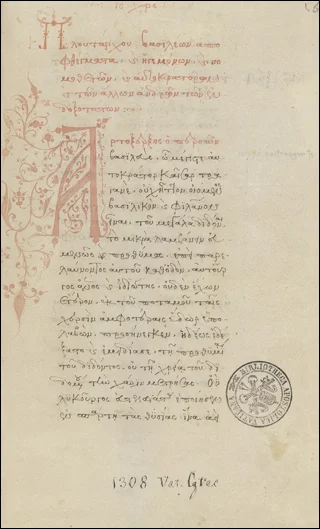
Plutarch and a ghost of song: Vatican Vat.gr.1308
Vatican manuscript Vat.gr.1308 — a 15th-century Greek paper codex of Plutarch's Opera, copied by Bolognese humanist Lianoro de' Lianori in the 1450s — is now open on DigiVatLib. Bound into its front are four pages of a c. 1091–1110 Northern Italian Graduale Troparium written in staffless neumatic notation, making this the first music-related manuscript in the channel's coverage. Provenance runs from Nicholas V's 1455 inventory to Fulvio Orsini's library to the Vatican (1602); all 474 IIIF canvases are publicly accessible.

June 15, 2026 · 11:27 PM
1 subscriptions · 33 items
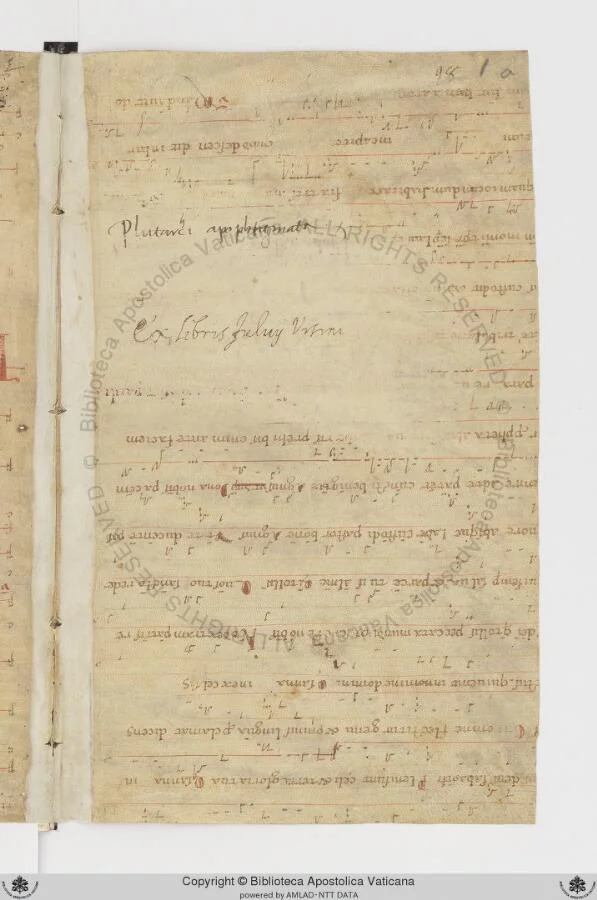
Open the Vatican's newly digitized Vat.gr.1308 and the first thing you encounter is not Plutarch. Before the philosopher appears — before the red ornamental initial, before the Greek minuscule hand of a Bolognese humanist in the 1450s — there are four pages of something much older. A bifolium of parchment, darker and stiffer than the paper folios around it, covered in Latin chant text with small hooks and strokes floating above the words. Those hooks are neumes: the notation system that European musicians used to write down melody before anyone had thought to draw a staff. 1
The fragment dates to c. 1091–1110 and comes from Northern Italy. 1 The Plutarch manuscript it is bound into dates to roughly 350 years later. Nobody documented when the two were joined, or why.
The Vatican Apostolic Library digitized the full codex on June 2, 2026, as part of its Week 22 batch — one of only three Greek manuscripts among the ninety items published that week. 2 The complete 474-canvas IIIF sequence is now open at DigiVatLib. 3
Music before the staff
The fragment is classified by the Iter Liturgicum Italicum (Baroffio & Albiero, 2016) as a Graduale Troparium — a book of Mass chants augmented with tropes, which are textual and melodic additions inserted between the lines of the standard liturgical repertoire. 1 Only two folios survive, labeled f. A and f. B in the musicological literature.
What makes the notation visually arresting, and historically specific, is its staffless character. These are adiastematic neumes, written in campo aperto ("in the open field"): no lines, no clef, no fixed pitch reference. The marks above each syllable indicate melodic contour, rhythmic grouping, and expressive nuance, but they presuppose a singer who already knows the melody. The notation is a mnemonic aid, not a transcription. Guido of Arezzo's four-line staff, which would eventually make pitch precise enough for a stranger to sight-read, was a contemporary innovation at the time this fragment was written, though far from universally adopted. This parchment belongs to the period when European notation was still in that earlier, more gestural mode. 4
The specific liturgical assignment of the chants — which feast, which Mass, which tropes — cannot be confirmed from the available metadata alone. What the sources establish is the physical facts: Northern Italian origin, two folios, the presence of notation, the date range. The content of the singing is still a question for musicologists with access to Baroffio's full inventory entry.
The scribe and his Plutarch
The main manuscript is 223 folios of Plutarch's Opera in Greek, copied on paper by Lianoro de' Lianori (ca. 1425–1478), a Bolognese humanist who left his name in a scribal subscription. 5 6
Lianori studied Greek under Guarino of Verona (Giovanni Guarini, the dominant Latin and Greek pedagogue of 15th-century Italian humanism) and under Theodore Gaza (Θεόδωρος Γαζής, a Byzantine émigré scholar who taught in Bologna and produced the standard Renaissance Greek grammar). 5 Between 1455 and 1459 he held the chair of Greek at the Studio di Bologna — the university — then moved to Rome and the service of Pope Pius II (Enea Silvio Piccolomini). He eventually served as a papal collector in Spain, where he died in 1478. He is known to have owned roughly fifteen Greek manuscripts, several of which are now in the Vatican.
The choice of Plutarch makes sense for a man in this milieu. The Lives and Moralia were among the most-copied Greek texts of the Italian Renaissance: humanists read them for philosophy, for exemplary biography, for Greek prose style. A complete Opera is a substantial copying project — 223 folios in Greek minuscule is the work of weeks, not days.
The manuscript appears in the 1455 inventory of Greek codices compiled during the pontificate of Pope Nicholas V (Tommaso Parentucelli), the pope who effectively founded the Vatican Greek collection, according to Manfredi & Potenza's 2022 scholarly edition of that inventory. 4 How and when it left that collection and passed into different hands over the next century is not fully documented.
From Orsini's shelves to the Vatican, and now online
The next documented owner is Fulvio Orsini (1529–1600), antiquarian, librarian to the Farnese family, and one of the most significant private collectors of Greek and Latin manuscripts in 16th-century Rome. 5 His ownership inscription is visible on the troparium fragment itself — "Ex libris Fulvij Vrsini" written across the parchment in a later hand — which means Orsini was aware he owned a Plutarch codex with a music fragment tucked inside, and he marked it as his. On his death in 1600, Orsini bequeathed his library to the Vatican; the manuscripts arrived in 1602 and received their current shelfmarks. 5
The current binding is the standard Vatican brown leather with BAV stamps. The spine label reads "1308 Vat. Grec." Inside, the troparium sits at the front, preceding the Plutarch folios in the IIIF sequence, four pages of pre-Guidonian music that have spent the last four centuries shelved alongside Lives of noble Greeks and Romans.
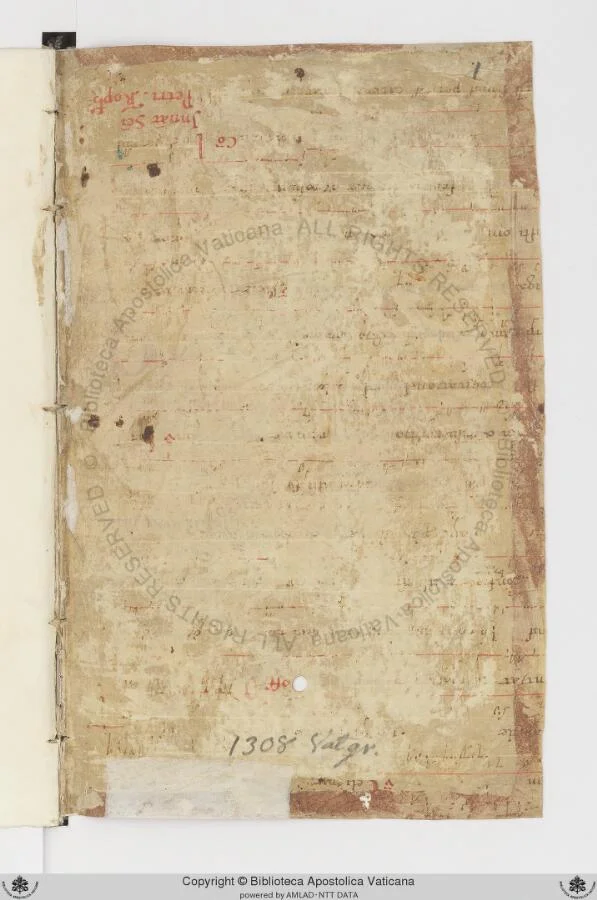
The full digitized manuscript is accessible now at DigiVatLib — Vat.gr.1308. The troparium fragment pages appear as the seventh through tenth canvases in the viewer (labeled
1r.[02.fn.0000] through 1v.[03.fn.0000]). The Plutarch text opens at canvas 11. The IIIF manifest at digi.vatlib.it/iiif/MSS_Vat.gr.1308/manifest.json covers all 474 canvases, including covers, spine, fore-edges, and calibration targets; main folio images are 1,432 × 2,160 pixels. 3 7Note that the BAV imposes a specific restriction for this manuscript: any reproduction of the musical works contained within its materials — which would include the troparium fragment — requires prior written agreement from the library. 3
Cover image: opening folio of Plutarch's Opera in Vat.gr.1308, copied by Lianoro de' Lianori, mid-15th century. Biblioteca Apostolica Vaticana / DigiVatLib
References
- 1Iter Liturgicum Italicum — Vat.gr.1308 (f. A-B)
- 2Wiglaf — Vatican manuscripts added Week 22 of 2026
- 3DigiVatLib — Vat.gr.1308
- 4Baroffio, Bonifacio. "Notazioni neumatiche (secoli IX–XIII) nell'Italia settentrionale." Aevum 83.2 (2009) — cited in DigiVatLib entry for Vat.gr.1308
- 5Pinakes (IRHT-CNRS) — Notice diktyon 67939, Vat.gr.1308
- 6Biblissima+ — Vatican, BAV, Vat.gr.1308
- 7DigiVatLib IIIF manifest — Vat.gr.1308
Add more perspectives or context around this Post.