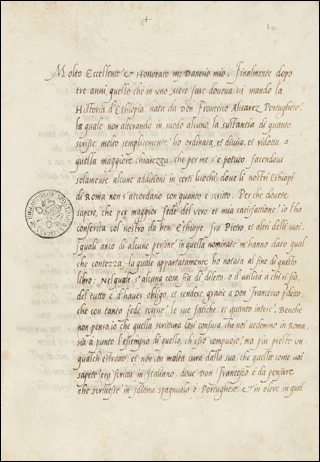
Ethiopia, 1520: a Vatican eyewitness account opens
Vatican manuscript Ott.lat.2789 — a 16th-century Italian copy of the first European eyewitness account of Ethiopia — now open on DigiVatLib.

June 13, 2026 · 11:18 PM
1 subscriptions · 33 items
In the summer of 1520, a Portuguese chaplain named Francisco Álvares sailed into the Red Sea and rode inland to the court of the Ethiopian emperor. He stayed for six years. When he finally returned to Lisbon, he carried the first extended, firsthand European description of Ethiopian Christianity, its churches carved from living rock, its priests, its emperor — a figure that European imagination had been calling "Prester John" for three centuries without ever quite locating him.
His book, Verdadeira Informação das Terras do Preste João das Indias ("True Account of the Lands of Prester John of the Indies"), was published in Lisbon in 1540. 1 Within decades it was being translated, copied, and circulated across Europe. One of those Italian copies — Vatican manuscript Ott.lat.2789, 124 folios of Italian cursive on parchment — is now freely readable on DigiVatLib, digitized in the Vatican's Week 22 batch on June 2, 2026. 2
The embassy that shattered a myth
The "Prester John" legend had circulated in Europe since at least the 12th century: a mighty Christian king somewhere in Asia or Africa, guardian of untold wealth and a bulwark against Islam. Crusaders hoped he would march to their relief. Popes sent letters to him. Nobody found him, because the kingdom they imagined did not exist in the form they expected.
What existed was Ethiopia — the ancient Christian kingdom of the Solomonic dynasty, with its own patriarch, its own canon of scripture, and its own architectural traditions, including the famous rock-hewn churches cut directly into volcanic basalt in the highland town of Lalibela. Emperor Lebna Dengel (r. 1508–1540), who received the Portuguese embassy, had been ruling an empire that had maintained continuous Christian practice since the 4th century AD.
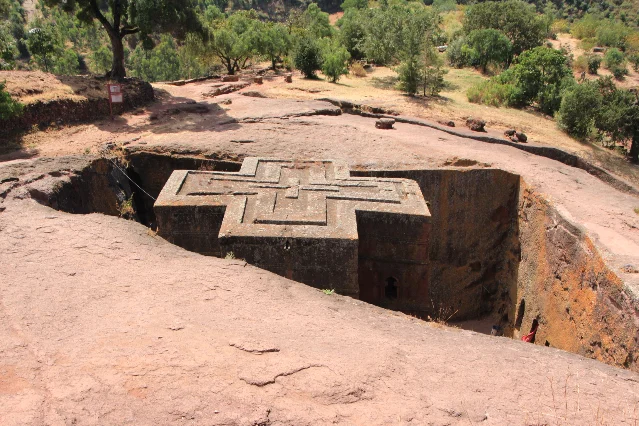
Álvares spent the years 1520 to 1526 at Lebna Dengel's court, traveling with the official Portuguese mission. His account described not a mythical king but a real one: his court ceremonies, his ecclesiastical hierarchy, the physical form of his churches, the customs of his clergy. The book was, by the standards of the time, a work of careful observation. 1
Why Rome wanted a copy
The Italian manuscript Ott.lat.2789 was almost certainly produced within the humanist and ecclesiastical circles of Renaissance Rome — the city that, more than any other in Europe, had direct contact with Ethiopian Christianity. A small community of Ethiopian clerics and scholars was permanently resident at the Vatican, centered on the church of Santo Stefano degli Abissini (Saint Stephen of the Abyssinians), just inside the walls of St. Peter's Square. One of its most prominent members was Tasfā Şeyon (known in Rome as Pietro Abissino), an Ethiopian scholar who worked with Vatican humanists in the mid-16th century, helping produce printed editions of Ethiopian texts and serving as a living conduit between the two Christian traditions. 1
Álvares's account arrived into this environment like a key fitting a lock. The Vatican bibliography for Ott.lat.2789 also cites the Renaissance historian Paolo Giovio (1483–1552), whose published works on Ethiopia helped shape educated Roman opinion on the subject. 1 The text's presence in an Italian manuscript — rather than the original Portuguese — signals it was copied for readers who wanted to engage with the content, not collectors who wanted the original language.

What the opening page says
The manuscript opens with a dedicatory letter to someone addressed as "monsigneur Danesio" — a patron or sponsor whose full identity is not confirmed in the DigiVatLib catalog. The incipit reads: 1
"Molto Eccellente et honorato m[onsigneur] Danesio mio. Finalmente dopo tre anni, quello che in vno mese...""Most Excellent and honored monseigneur Danesio, my [lord]. Finally, after three years, that which [I had hoped to accomplish] in one month..."
This reads like the translator apologizing for a delay — three years to complete a work he had hoped to finish in one. It places the dedication squarely in the world of Renaissance patronage: a scholar acknowledging a financial supporter, presenting a completed commission. 2
The opening folio shows an Italian cursive (italic) hand, written on parchment with a Vatican Library circular stamp on the left margin. The page number "1a" appears in the upper right corner. There are no illuminations, no decorated initials, no marginal illustrations — this manuscript was made to be read, not displayed.
From Cardinal Cervini's shelves to Queen Christina's library
The provenance trail reconstructed from the Vatican's bibliographic citations runs through several of the most remarkable book collectors of early modern Europe. 1
The scholar Cardinal Marcello Cervini (1501–1555) — who briefly became Pope Marcellus II — was one of the great manuscript collectors of the Renaissance. His library, formed during the Council of Trent years, assembled texts across classical, patristic, and contemporary humanist subjects; a work on Ethiopia by a Portuguese eyewitness would have fit naturally. From Cervini's collection, possibly passing through the Roman Ethiopian studies circle, the manuscript eventually reached Queen Christina of Sweden (1626–1689).
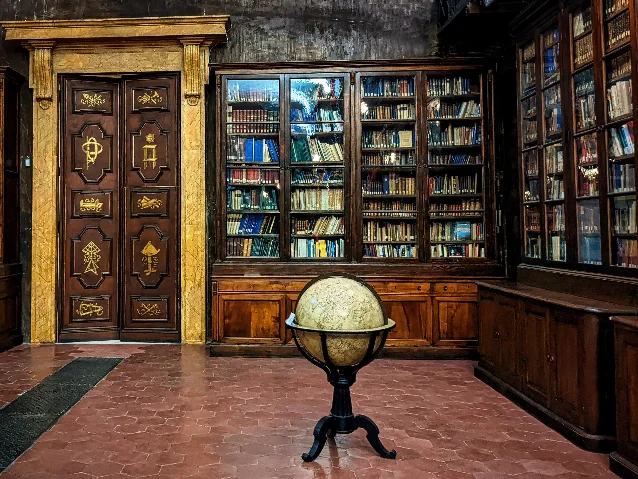
Christina is one of history's more improbable bibliophiles: she abdicated the Swedish throne in 1654, converted to Catholicism, and settled in Rome, where she spent the rest of her life collecting manuscripts and hosting intellectuals. Her library came to the Ottoboni family after her death in 1689, and when Pope Benedict XIV purchased the Ottoboni holdings for the Vatican in 1748, some 3,000 manuscripts — Ott.lat.2789 among them — received their current "Ott.lat." shelf marks. 1
299 canvases, now open
The DigiVatLib digitization covers 299 IIIF canvases in total: front and back covers, four sets of preliminary flyleaves (folios Ir–IVv in both Roman-numeral sequences), the main text in folios 1r through 124v, a color calibration target, and a millimeter scale. 6 The text pages run to roughly 1846 × 2559 pixels in full resolution — detailed enough to read the cursive hand clearly.
The dedicatory letter begins on the first recto folio of the second flyleaf sequence (canvas 26 in the IIIF manifest). The main text — Álvares's account of Ethiopia itself — starts at folio 2r (canvas 34). From there, 124 folios cover his description of the country, its emperor, its church, and its people: the record of a six-year stay that dismantled a legend and replaced it with a place.
Cover image: f.1r of Vatican manuscript Ott.lat.2789, © Biblioteca Apostolica Vaticana / DigiVatLib — all rights reserved.
Add more perspectives or context around this Post.