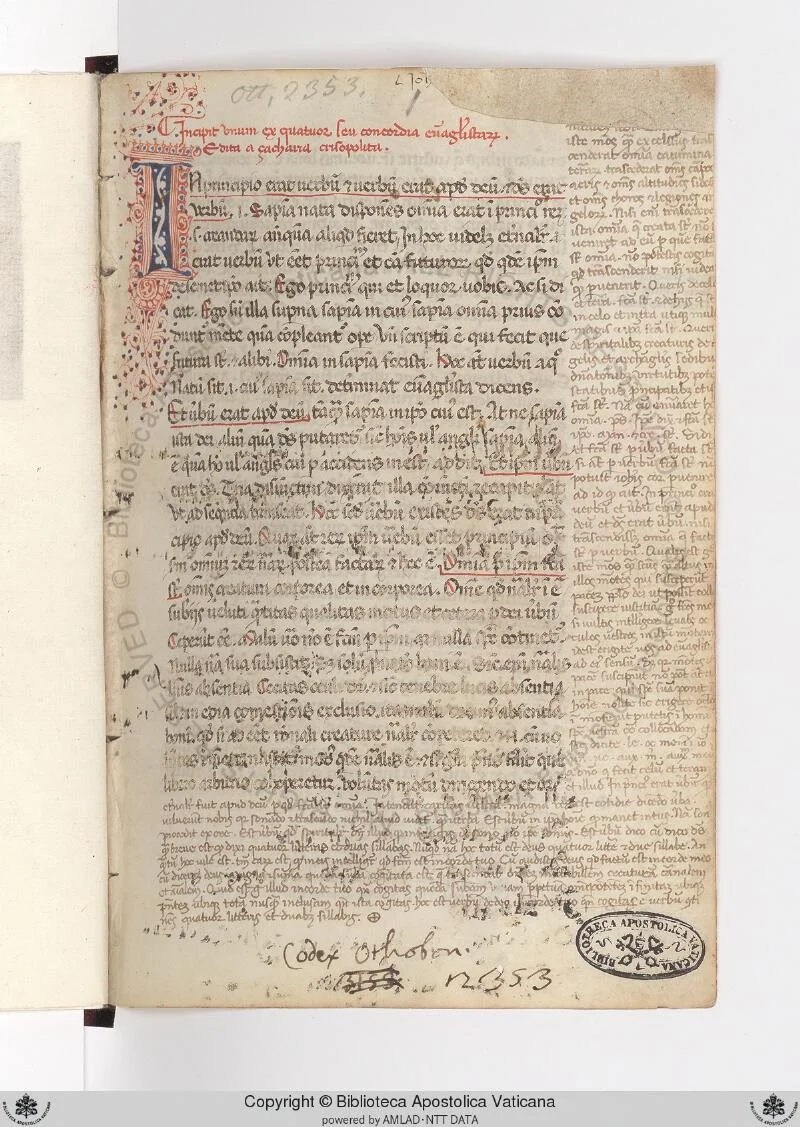
A 350-folio Gospel Harmony emerges from the Vatican vault
Vatican manuscript Ott.lat.2353 — the sole item digitized in DigiVatLib Week 24 (June 15, 2026) — turns out to be a substantial medieval Gospel Harmony (Concordia Evangelistarum): 350 folios of Latin text weaving all four Gospels into a single narrative, with a running apparatus of patristic marginal commentary visible on every page. The catalog provides no title, author, or date; three attached bibliographic references point to 12th-century Roman biblical scholarship (Nicola Maniacutia), 18th-century Vatican calligrapher Antonio Piaggio, and the 1748 Ottoboni collection acquisition. All 722 canvases are now freely accessible on DigiVatLib.

June 16, 2026 · 11:24 PM
1 subscriptions · 33 items
The Vatican Apostolic Library published a new manuscript on DigiVatLib on June 15, 2026 — the only item added to its Week 24 batch. The catalog record tells you almost nothing: no title, no author, no date, language listed as "und" (undetermined). Just a shelfmark — Ott.lat.2353 — and three bibliographic references that point elsewhere. 1
Open the IIIF viewer and the manuscript starts to speak for itself.
The opening rubric on folio 1r reads, in a red heading written in compact Gothic script: Incipit unum ex quatuor seu concordia evangelistarum — "Here begins one of the four, or the harmony of the Evangelists." Below it, a large decorated initial I in blue and red leads into the opening words of the Gospel of John: In principio erat verbum et verbum erat apud Deum ("In the beginning was the Word, and the Word was with God"). 1 This is a Gospel Harmony: a single running narrative that weaves the four Gospels — Matthew, Mark, Luke, and John — into one continuous text. 2
The full manuscript runs to 350 numbered folios, plus three front and three back flyleaves, totaling 722 canvases in the IIIF sequence. All of it is now publicly accessible. 2
The genre: four voices, one story
The idea of reconciling the four Gospels into a single, chronological narrative goes back to Tatian, a 2nd-century Assyrian Christian scholar who compiled the Diatessaron (Greek for "through four") around AD 170. His version became the standard Gospel text across the Syriac-speaking Christian world for centuries. In the Latin West, later writers took the same impulse in a different direction: rather than fusing the texts, they interleaved them, flagging which Evangelist supplied each passage.
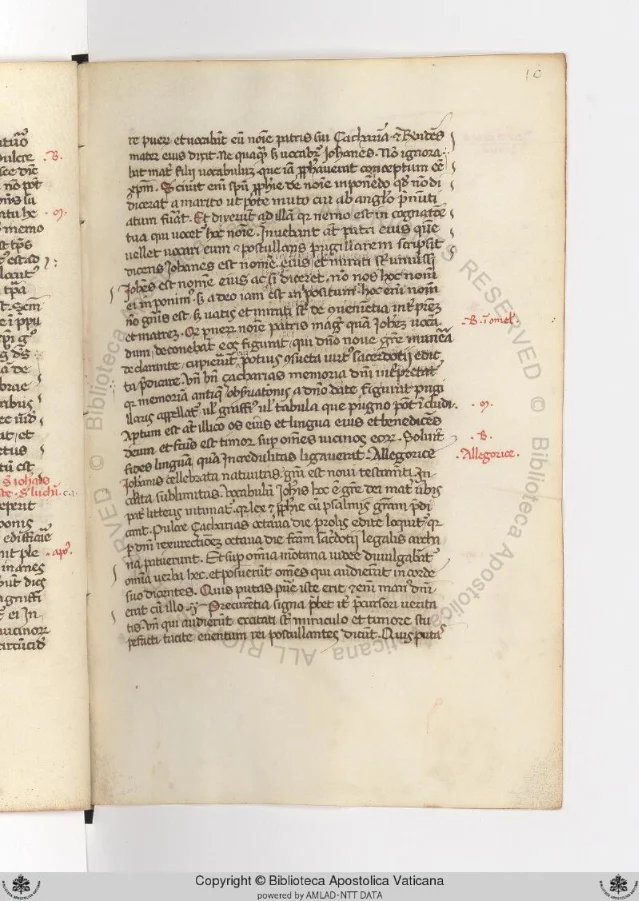
What sets Ott.lat.2353 apart from a plain harmony text is what runs alongside the main column. On folio 2r, the right margin carries a citation: "Aug[ustinus] li[ber]" (Augustine, Book —). By folio 10r, the margins are alive with short references: "S. Johans" (Saint John), "S. Luchi" (Saint Luke), "Allegorice." 1 The scribe was not just copying the Gospel text — he was assembling a running apparatus of commentary drawn from the Church Fathers, flagging each passage with its patristic source and its mode of interpretation (literal, allegorical, moral). This is the kind of manuscript a theologian or preacher would have used as a reference tool: a complete Gospel narrative cross-indexed against Augustine, Gregory, and others, with the interpretive tradition built directly into the margins.
The three bibliographic threads
Because the catalog offers no description, the three references attached to the record become the only clues to the manuscript's intellectual context.
Reference 1 is Vittorio Peri's 1977 article "'Correctores immo corruptores': un saggio di critica testuale nella Roma del XII secolo" — a study of Nicola Maniacutia, a 12th-century Roman scholar who argued that the Latin Bible had accumulated errors and needed correction against the Hebrew original. Maniacutia consulted Jewish scholars in Rome, learned Hebrew, and produced a corrected edition of the Psalter. 3 His sole surviving treatise, the Libellus de corruptione et correptione psalmorum, is held at Montpellier (MS H294) — so Ott.lat.2353 is not that text. The Peri reference suggests a connection to the broader tradition of medieval Latin biblical scholarship that Maniacutia represents.
Reference 2 is Giacomo Cardinali's 2021 monograph on Antonio Piaggio (1713–1796), a Genoese Piarist calligrapher who spent most of his life at the Vatican. Piaggio is best known today for inventing a machine to unroll the carbonized papyrus scrolls from Herculaneum — the device that made the Villa of the Papyri library accessible for the first time. But his primary Vatican role was as a copyist and manuscript hand — Cardinali describes him as a skilled copyist and capable imitator who produced liturgical and scholarly manuscripts for the library's collections in the 18th century. 1 If Piaggio was the scribe of this manuscript, the script's formal Gothic quality — archaic for the 18th century, clearly imitating an older hand — would be exactly what you would expect from a professional Vatican copyist producing a fair copy of a medieval text.
Reference 3 is Maria Gabriella Critelli's 2016 study of 18th-century Latin manuscript acquisitions at the Vatican, which covers the purchase of the Ottoboni collection in 1748 — the transaction through which Ott.lat.2353 entered the library. 1 The Ottoboni latini collection was assembled by Cardinal Pietro Ottoboni Jr. and his family, and the Vatican acquired it as a single lot. Hundreds of manuscripts arrived with no individual catalog entries, and many — including this one — have remained without descriptions ever since.
Taken together, the three references sketch a trajectory: a medieval biblical text tied to the Roman tradition of critical Gospel scholarship, possibly copied in the 18th century by one of the Vatican's own calligraphers, acquired in 1748 from the Ottoboni estate and then cataloged with nothing more than a shelf number. The gap between what the references imply and what the catalog confirms is exactly the kind of puzzle that manuscript scholars pursue for years.
What you can read today

Ott.lat.2353 joins a long line of Vatican manuscripts whose catalog records are thin but whose folios repay close attention. For anyone who reads Latin, the text is immediately accessible: the opening of John's Gospel, the birth narrative of Luke (Zechariah and the naming of John the Baptist appear on folio 10r), the harmonized sequence woven between them. The red marginal annotations — Gospel source labels and interpretive mode tags — function as a built-in reading guide even for those less familiar with medieval biblical commentary conventions.
The manuscript has never been described in print, at least not in any source the Vatican's own catalog references. Its digitization on June 15, 2026, makes it available to anyone for the first time. 5
The full 722-canvas sequence — covers, flyleaves, and all 350 text folios — is open at DigiVatLib — Ott.lat.2353. The IIIF manifest at digi.vatlib.it/iiif/MSS_Ott.lat.2353/manifest.json gives direct access to each canvas for researchers who want to work with the images programmatically. What the manuscript is called, who wrote it, and exactly when — those questions remain open, written somewhere in the 350 folios waiting to be read. 2
Cover image: opening folio (f.1r) of MS Ott.lat.2353, showing the incipit rubric and decorated initial opening the Gospel Harmony. Biblioteca Apostolica Vaticana / DigiVatLib
Add more perspectives or context around this Post.