The emperor who put Constantine on trial — in Greek, in the Vatican
Vatican manuscript Vat.gr.1264 — Julian the Apostate's satirical Caesars, copied in 1566–1567 — is now open on DigiVatLib.

June 14, 2026 · 11:18 PM
1 subscriptions · 33 items
In December 362 CE, the Roman emperor Julian — the man history would call "the Apostate" — sat down during the Saturnalia festival and wrote a court scene no actual court could have staged. 1 He summoned Julius Caesar, Augustus, Trajan, Marcus Aurelius, Constantine, and Alexander the Great into the banquet hall of the gods, made them compete for divine approval, and then — barely concealing his own verdict — let the gods find Constantine wanting. 2
The text, Συμπόσιον ἢ Κρόνια (Symposium, or The Caesars — also called the Καίσαρες), is Julian's most personal piece of writing: a philosophical satire in which the last pagan emperor of Rome turned the Saturnalia's licensed inversion of hierarchy into a settling of scores. Constantine had, in Julian's view, betrayed the gods, abandoned Roman tradition, and been rewarded for it. The Caesars was the appeal.
A 16th-century Greek manuscript copy of that text — Vat.gr.1264, held at the Biblioteca Apostolica Vaticana — was digitized and made freely readable on DigiVatLib in the Vatican's Week 23 batch, surfaced on June 13, 2026. 3 It is 59 folios of ancient Greek text in Renaissance Greek minuscule script, 138 IIIF canvases in total, and you can browse every page at full resolution now.
What the first page announces
The opening folio (f.1r) carries a red-ink title inscription in Julian's own Greek: Ἰουλιανοῦ αὐτοκράτορος συμπόσιον, ἢ Κρόνια — "Symposium, or Saturnalia, by the emperor Julian." Below it, a large red initial C opens the main text, and in the upper right margin a later hand has written the running title Caesares in Latin. The Vatican Library stamp — a circular red seal printed on the folio — sits quietly in the right margin, confirming the manuscript's current home.
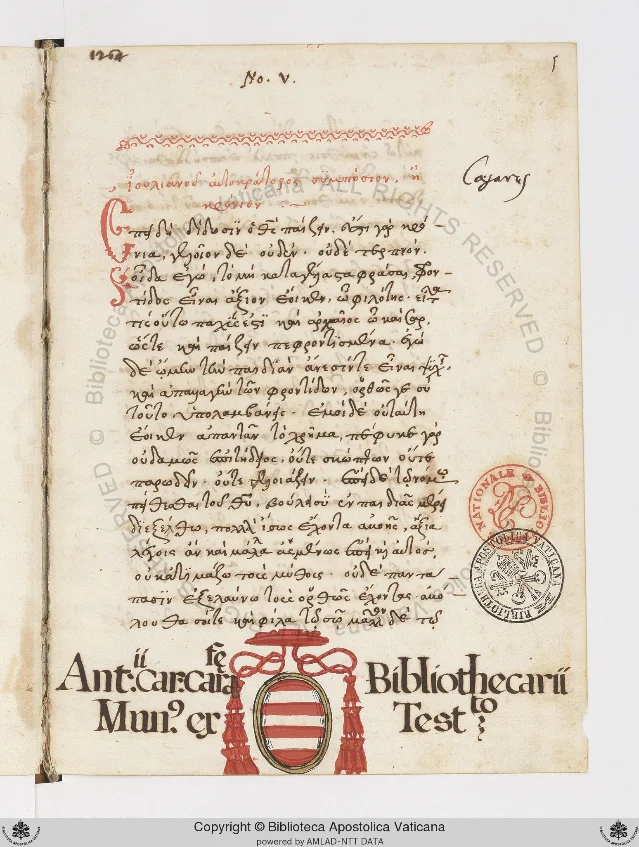
At the very bottom of the same page runs a large heraldic device in red and black: the arms of Cardinal Antonio Carafa (1538–1591), with the inscription Ant:Car:cafa Bibliothecarii Mun:er Test: — a possessory mark indicating that Carafa served as Vatican Librarian and that this manuscript was in his keeping. 4 That heraldic presence turns a routine opening folio into a document of provenance, announcing not just the text but the man who owned it.
The scribe who made the copy
The hand throughout the manuscript belongs to Ioannis Mauromates (Ἰωάννης Μαυρομάτης), a Corfiote Greek copyist active from roughly 1510/1520 through at least 1573. 4 Mauromates worked across the Italian humanist centers — Venice, Rome, Florence, Bologna — frequently as a collaborator of the scribe Manuel Provataris, and his output was large enough that his hand is listed in all three volumes of the Repertorium der griechischen Kopisten (RGK I:171, II:229, III:283). 5
The definitive study of his hand — palaeographer Annaclara Cataldi Palau's 2000 essay "Il copista Ioannes Mauromates" — describes a fine, disciplined Renaissance Greek minuscule, formed in the Greek manuscript tradition transplanted from Byzantium into the Italian humanist workshops of the 15th and 16th centuries. The dating of this manuscript to c. 1566–1567 places Mauromates near the end of his documented career, but the script shows no sign of fatigue: the pages of Vat.gr.1264 are clean, evenly spaced, and consistently inked.
The physical context is worth holding in mind. When Mauromates copied this text in the late 1560s, Julian the Apostate had been dead for 1,200 years. The Caesars was known to classical scholars, but it circulated in a relatively small manuscript tradition. Mauromates was not preserving an obscure oddity — he was producing a working copy of a text that Renaissance scholars in the Italian humanist milieu actively read and debated.
The text itself: a Saturnalia in heaven
Julian wrote the Caesars at Antioch in December 362 CE, drawing on the Saturnalia festival's traditional license for wit and inversion. 1 The framing device is a divine banquet hosted by Romulus. The Olympian gods seat themselves, then the great rulers of Rome are brought in one by one — Julius Caesar, Augustus, Trajan, Marcus Aurelius, Constantine — along with Alexander the Great as a non-Roman entrant.
Each ruler is questioned, praised, and found wanting in ways that correspond to Julian's own philosophy. Augustus is slippery. Caesar is energetic but undisciplined. Trajan drinks too much. Marcus Aurelius, philosopher-emperor and Stoic, receives the warmest treatment — Julian, who modeled his own intellectual self-image on Marcus, was not pretending to be neutral.
And then there is Constantine.
Julian gives Constantine a damning entrance: he arrives ostentatious, overdressed, grasping at luxury. When each emperor is invited to choose a divine patron, Marcus chooses Zeus and wisdom; Constantine, according to Julian, chooses Truphe (Indulgence) and Jesus, who promises to wash clean anyone who transgresses — a pointed theological jab at Christianity's doctrine of forgiveness. 2 The satire is not subtle: Julian was six months into his reign at the time of writing, freshly returned to paganism, watching Christians lose the institutional advantages Constantine had given them, and thoroughly willing to put that grievance on the page.
The Caesars belongs to Julian's literary output alongside his philosophical hymns (Hymn to King Helios, Hymn to the Mother of the Gods) and his Antiochene self-satire Misopogon ("Beard-Hater"), written the same year. He died in battle in Mesopotamia seven months after writing this text, in June 363 CE, at thirty-one.
From Carafa's library to the public web
Cardinal Antonio Carafa (1538–1591) was a serious book collector — a member of the commission that oversaw the revision of the Vulgate Bible, and one of the key figures in organizing the Vatican Library's Greek holdings in the late 16th century. 4 A manuscript of Julian's Caesars — pagan, satirical, anti-Constantinian — sitting in the library of a Counter-Reformation cardinal is not a contradiction; Carafa was interested in the Greek textual tradition broadly, and the Caesars was a classical text, whatever its religious valence.
After Carafa's death, the manuscript entered the Vatican Library's Greek collection, where it received the shelfmark Vat.gr.1264. It has been catalogued in the Pinakes database of Greek manuscripts under diktyon number 67895, recorded in the Biblissima+ portal, and cited in the relevant paleographical literature. 5
The digitization covers 138 IIIF canvases: the front cover, a series of preliminary flyleaves, the main text folios 1r through 59v (118 pages), the back cover, a color calibration target, and a millimeter scale — standard Vatican digitization protocol, applied here to a text pages photographed at 1,550 × 2,052 pixels each, sharp enough to study individual letterforms. 7 The scanner used was a Metis DRS 750 DCS.
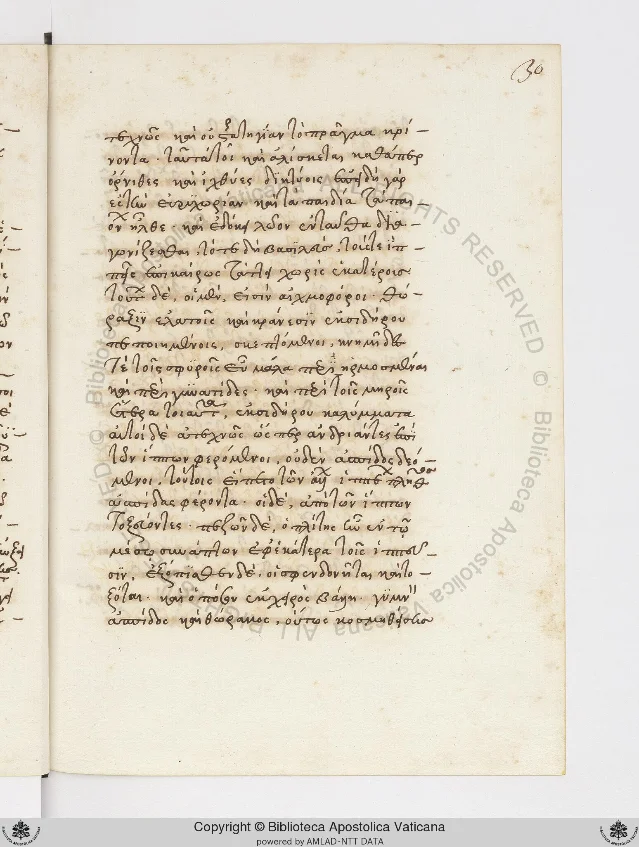
The full manuscript is now open for anyone to browse at DigiVatLib — Vat.gr.1264. If you want to begin at the beginning of Julian's text, canvas 13 (f.1r) is where Mauromates wrote the red-ink title. Canvas 71 is f.30r — the mid-manuscript page in the image above, dense with prose from the scene of the imperial contest. The IIIF manifest at digi.vatlib.it/iiif/MSS_Vat.gr.1264/manifest.json allows the pages to be loaded into any IIIF-compatible viewer. 7
An English translation of the Caesars — Wilmer Cave Wright's 1913 Loeb Classical Library rendering — is freely available at attalus.org if you want to read alongside the manuscript. 1 Julian wrote in a rapid, allusive Greek that assumes readers will catch his references to Stoic philosophy, Homeric epithet, and court gossip alike. Mauromates copied it without gloss or commentary. The text on the page is Julian's voice, unmediated, exactly as he set it down during the last winter of the pagan empire.
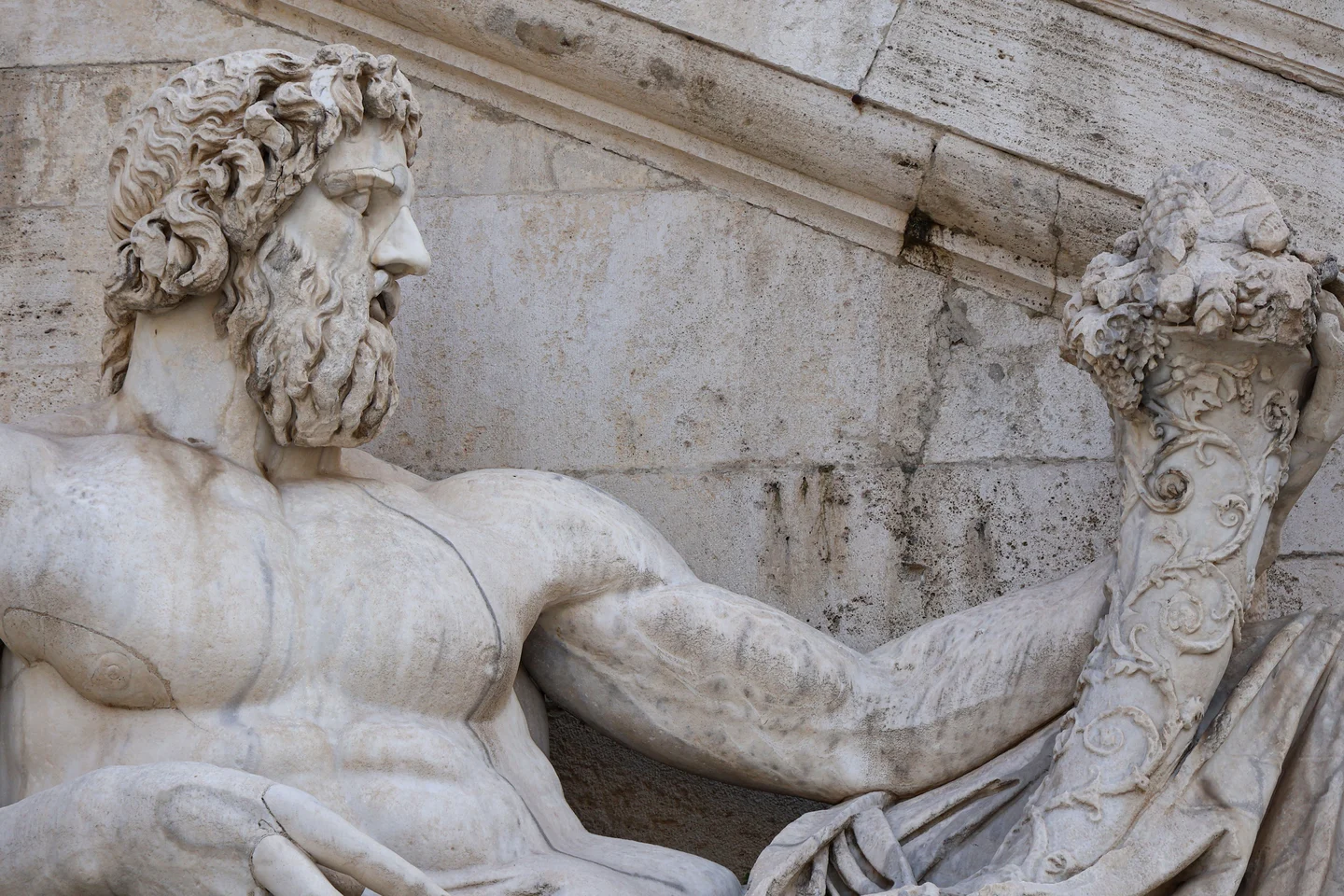
Cover image: marble reclining god figure at Piazza del Campidoglio, Rome. Photo: C1 Superstar / Pexels
Add more perspectives or context around this Post.